
November 12, 2026
Has AI Made Offshore Software Development Obsolete?
For decades, businesses have turned to offshore software developers for one main reason: cost. Hiring developers overseas often meant significantly lower hourly rates than working with a U.S.-based team.
But what if a U.S. development team could build your software faster, communicate with you in real time, and deliver the finished product at a comparable cost?
Artificial intelligence is making that possibility increasingly realistic.
AI-powered tools are helping experienced developers complete projects in fewer hours. Combine that efficiency with the advantage of working in the same time zone, and the traditional cost benefits of offshore development become less convincing.
The question is no longer who charges the lowest hourly rate. It’s who can deliver quality software the fastest, at the best overall value.
The Hidden Cost of Offshore Software Development: Time
Offshore software development has traditionally been attractive because of lower labor costs. However, an inexpensive hourly rate doesn’t always mean a faster or more affordable project.
One of the biggest challenges is the time difference.
Imagine your company is based in Kansas and your development team is in India. You review a new software feature on Tuesday morning and notice something needs to change. You send an email explaining the issue, but your offshore developers have already finished their workday.
They review your feedback overnight and respond with a question. When you arrive at work Wednesday morning, you answer it. Unfortunately, their workday is nearly over again.
A simple question that could have been resolved in a five-minute conversation may now take 24 to 48 hours to work through.
Multiply that delay across dozens of questions, revisions, and development milestones, and a project can stretch weeks or even months longer than necessary.
For businesses without an internal CTO or technical team, these delays can be especially frustrating. Managers and business owners often need developers to help them make decisions, not just write code.
A U.S.-based team working during the same business hours can address questions immediately, make adjustments, and keep the project moving.

AI Is Making U.S. Software Developers Faster Than Ever
The biggest change AI brings to software development isn’t replacing developers. It’s making experienced developers significantly more productive.
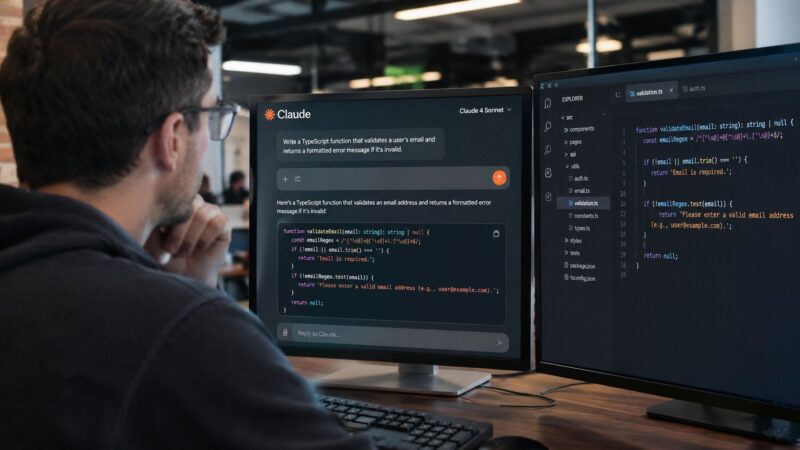
Tools like Anthropic’s Claude Code can help developers write code, identify bugs, build automated tests, and understand complicated software systems quickly.
Tasks that previously required hours of manual coding can sometimes be completed in a fraction of the time.
For example, a feature that once required 40 development hours might take an experienced developer just 15 or 20 hours with AI assistance. Actual savings vary depending on the project, but the potential is significant.
This changes the economics of software development.
A U.S. developer may charge more per hour than an offshore developer, but if AI allows that developer to complete the work in substantially fewer hours, the total project cost can become competitive.
And when you combine AI-powered efficiency with faster communication, the advantages extend beyond the development hours themselves.

Faster Development + Faster Communication = Faster Projects
AI can speed up the technical work, but it doesn’t eliminate the need for communication.
Developers still need to ask questions, understand business requirements, review feedback, and make decisions with customers.
This is where U.S.-based development teams have another major advantage.
Consider a typical software development scenario:
With an offshore team: A developer encounters a question about how an inventory system should handle a particular transaction. Because of the time difference, they may need to wait until the next day for an answer. If the answer leads to another question, the delay continues.
With a U.S.-based team: The developer can call or message the customer during normal business hours, get clarification, and continue working the same day.
Now add AI to the equation. Once the question is answered, the developer can use AI to implement and test the solution faster than traditional development methods might allow.
This creates two opportunities to save time: less time writing code and less time waiting for answers.
Over the course of a project, those efficiencies can make a meaningful difference in both delivery timelines and overall costs.
Does Offshore Development Still Save Money?
It certainly can, but businesses need to look beyond hourly rates.
Consider a hypothetical software project comparing a traditional offshore team charging $50 per hour with an AI-powered U.S. team charging $150 per hour.
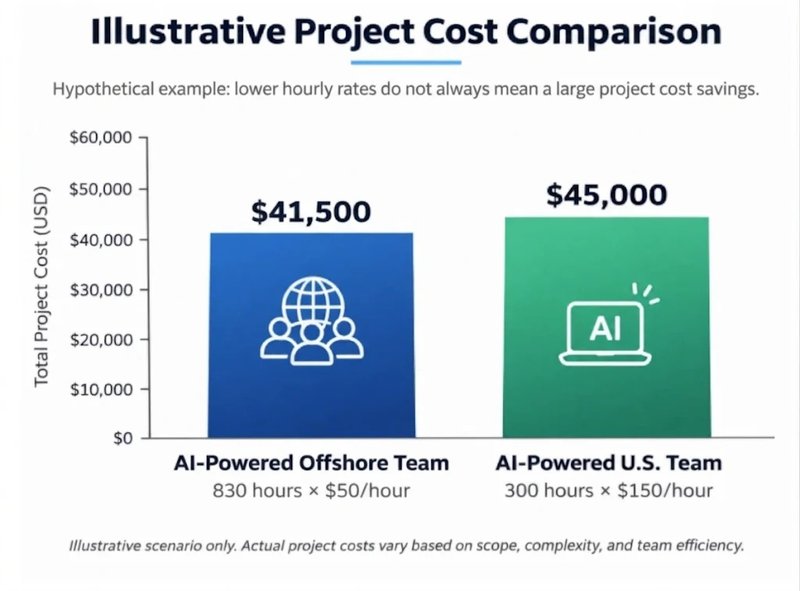
In an illustrative scenario, the offshore team takes 1,000 hours, costing $50,000. The U.S. team completes the same work in 300 hours using AI, costing $45,000.
That’s a potential $5,000 savings despite the higher hourly rate.
These figures aren’t guaranteed outcomes. AI productivity gains vary, and offshore developers can use AI too. But the example shows why comparing hourly rates alone can be misleading.
The U.S. team may also reduce the time spent waiting for feedback, coordinating meetings, and correcting misunderstandings. That could mean launching the software sooner and putting it to work for your business faster.
Experienced Developers Still Make the Difference
AI can write code quickly, but it doesn’t automatically understand your business.
Think of AI as an exceptionally fast intern who never clocks out. It’s productive, but it needs seasoned professionals to guide its work.
Experienced developers understand software architecture, security, integrations, and long-term maintenance. They know when AI-generated code is appropriate and when it needs to be corrected.
For companies in agriculture, transportation, manufacturing, or oil and gas, having developers who understand their operations is especially valuable.
Sometimes that means getting everyone on a call. Other times, it means visiting a facility to see firsthand how employees use an existing system.
Those conversations help prevent misunderstandings before they turn into expensive development mistakes.
At Flint Hills Group, we frequently work with businesses that don’t have their own CTO or development department. We serve as their software development team, helping them plan, build, modernize, and maintain their systems.
Is Offshore Software Development Becoming Obsolete?
Not entirely. Offshore teams are adopting AI too, and many have talented developers. For some projects, offshore development will remain a good option.
But AI is changing the competitive landscape.
The lower hourly rates that once made offshoring an obvious choice may no longer outweigh the combined benefits of AI-powered development, real-time communication, and experienced U.S.-based developers.
Businesses should consider not just what software costs to build, but how quickly it can be delivered and start providing value.
The cheapest hourly rate doesn’t necessarily produce the cheapest project, and it certainly doesn’t guarantee the fastest delivery.

Build Software Faster With Flint Hills Group
At Flint Hills Group, we’re embracing AI-powered software development to help our customers build and modernize software faster and more cost-effectively.
As a member of the Claude Partner Network, we’re using Anthropic’s Claude technology to improve development efficiency while maintaining the quality, expertise, and personal service our customers expect.
Before assuming offshore development is your most affordable option, consider what an experienced U.S.-based team using AI could accomplish.
Contact Flint Hills Group today to discuss how we can help you build better software, faster.

Kaylee Blubaugh
Software Project Manager / Head of Marketing
Kaylee combines her background in marketing, team leadership, and technology to help create thoughtful, valuable products and digital experiences. With 15 years of marketing experience, she brings a strategic perspective to both software development and brand communication.


