

September 16, 2026
AI, No AI, or Somewhere in Between: Your Options for Custom Software Development
AI, No AI, or Somewhere in Between: How We Build Custom Software
Artificial intelligence is changing how software gets built. AI can help developers write code, create mockups, test features, solve bugs, and speed up other parts of development. In the right situations, it can save time and reduce project costs.
But that does not mean every software project needs to use AI. At Flint Hills Group, we can use AI throughout a project, use it only in certain areas, or not use it at all. The choice depends on what the client is comfortable with and what makes sense for the project.
AI Does Not Have to Be All or Nothing
Some companies want to use AI as much as possible. They want to move faster, test ideas sooner, and find ways to reduce development time. Other companies are more cautious and may only want AI used in specific parts of the process.
For example, a company may be comfortable with AI helping create mockups, write code, or generate tests, but not want sensitive data used with AI tools. Others may have internal policies that limit AI use. Some companies do not want AI involved at all.
We can work with any of those approaches. Our goal is not to push clients toward AI. It is to build the right software using a process they trust.
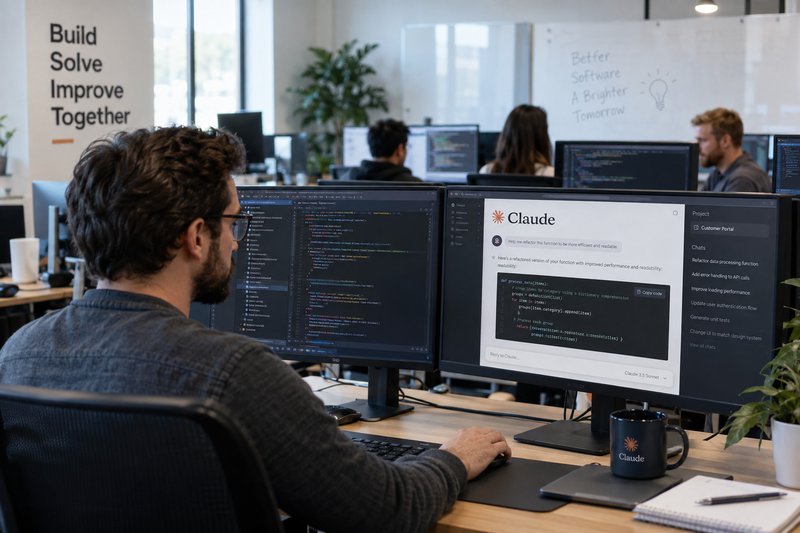
Option 1: Using AI Throughout Development
For clients who are comfortable with AI, we can use AI-assisted tools across many parts of a software project. That does not mean handing the whole project over to AI. Our developers are still responsible for the system design, code quality, security, testing, and final product.
Instead, AI becomes another tool that helps the team work faster. Depending on the project, we may use it to:
- Create early interface concepts and mockups
- Help write or refine code
- Build repetitive features faster
- Find and fix bugs
- Refactor older code
- Generate test cases
- Review code
- Create technical documentation
- Research possible solutions
- Speed up prototypes and proof-of-concept work
Those time savings can add up across a large project. We have already seen projects where AI helped our team make progress faster than we would have with a traditional process alone.
Even then, experienced developers still guide the work. They review the output, make technical decisions, and make sure the software works the way it should. AI helps the team; it does not replace the team.
Option 2: Using AI Only in Certain Areas
For many companies, a mixed approach makes the most sense. You may want some of the speed AI offers without using it everywhere.
We could use AI to help create mockups or assist with development while keeping private business information out of AI tools. It may also make sense to use AI for testing, documentation, or repetitive coding tasks while keeping it away from parts of the system that handle sensitive data.
The exact boundaries are up to the client. We can decide at the beginning of the project where AI can be used and where it should not be used. Those rules can also be adjusted later if needed.
This approach can work well for businesses that are interested in AI but still have concerns about privacy, intellectual property, customer data, or company policies. AI does not need to be an all-or-nothing choice.

Option 3: Building Software Without AI
Use of AI is not required to work with Flint Hills Group. If your company does not want AI used during development, we can follow a traditional software development process.
There are plenty of reasons a company may prefer this approach. You may have an internal policy that does not allow AI tools, your project may involve sensitive information, or your industry may have strict requirements. Leadership may simply be more comfortable keeping AI out of the process.
Whatever the reason, we can work within those limits. Our developers were building custom software long before today’s AI tools existed, and the basics of strong software development have not changed.
Good software still requires careful planning, solid architecture, clean code, testing, security, and clear communication. AI can help speed up parts of the work, but it is not required to build dependable software.
What About Your Data?
Data is one of the biggest concerns companies have about AI, and it is an important part of the conversation. There is a major difference between using AI to help create a basic software component and giving an AI tool access to private customer records or company information.
Those decisions should be made carefully. If certain data should never be used with AI tools, we can set that rule from the start. If your company already has an AI policy, we can follow it. And if the policy is simply “no AI,” we can work that wa
The Goal Is Better Software, Not More AI
Most companies do not come to us because they want AI. They come to us because they have a business problem that needs to be solved.
Maybe an old system is hard to maintain. Employees may be using spreadsheets to manage an important process, or the company may have outgrown off-the-shelf software. In other cases, a founder has an idea for a new platform or needs software that connects with equipment in the field.
Our goal is to solve that problem. Sometimes AI can help us do that faster. In other cases, it only makes sense for part of the project, and there are also times when it should not be used at all.
We do not force AI into a project just because the technology is available.

You Do Not Need to Have It All Figured Out
Many of the companies we work with do not have a CTO or an internal software team. The person reaching out may be a founder, manager, director, or operations leader who has been asked to solve a software problem.
You do not need to know exactly how much AI should be used before talking with us. We can explain the options, where AI may help, and where it may create concerns. From there, we can agree on an approach that fits your company.
Your Software, Your Choice
AI gives software teams new ways to work faster and more efficiently, but it should not take control away from the client. If you want us to use AI wherever it can help, we can. If you want it limited to certain parts of the project, we can do that too. And if you do not want AI used at all, that is also an option.
The goal is not to use as much AI as possible. The goal is to build software that works for your business using a development process you are comfortable with.
Navigate Your AI Decisions With Confidence
Flint Hills Group is trained in Anthropic’s Claude AI solutions and is a proud Claude Code Partner. That experience allows us to help clients understand where AI can add value, where a more traditional approach may make sense, and how to set the right boundaries for their software projects.
Reach out to Flint Hills Group today to navigate the new AI decisions your business is facing and find the right approach for your software needs.

Kaylee Blubaugh
Software Project Manager / Head of Marketing
Kaylee combines her background in marketing, team leadership, and technology to help create thoughtful, valuable products and digital experiences. With 15 years of marketing experience, she brings a strategic perspective to both software development and brand communication.
Kaylee Blubaugh
Software Project Manager / Head of Marketing
Kaylee combines her background in marketing, team leadership, and technology to help create thoughtful, valuable products and digital experiences. With 15 years of marketing experience, she brings a strategic perspective to both software development and brand communication.
